
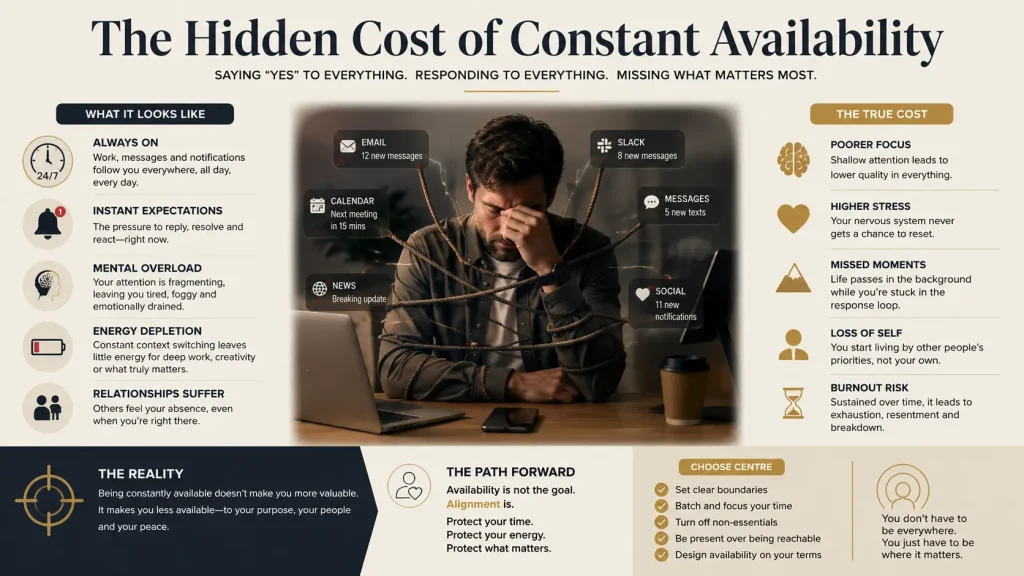
Being available can seem like a generous quality.
You become the person people can count on.
The reliable one.
The skilled one.
The one who knows how to fix things, move things, solve things and make life easier for others.
But over time, constant availability can quietly become an open invitation for people to organise your life around their needs.
Without realising it, you begin wearing an invisible label.
You may not see it, but others do.
Ask him.
He’ll help.
He knows how to do it.
He won’t say no.
And somehow, before you have even had time to think, you are pulled onto another tangent.
Someone needs help moving.
Someone needs a hand with a renovation.
Someone has a problem that suddenly becomes your problem.
And because helping is in your nature, you jump in.
Not because you planned to.
Not because it fits your day.
But because the request appeared, and your reaction answered before your awareness had a chance to speak.
The difficulty is that we cannot be in two places at once.
We may have our own obligations, our own thoughts, our own needs and our own direction. But when we are constantly responding to everyone else’s needs, we slowly become disconnected from our own.
And then comes the quiet question:
What happens when I need help?
Sometimes, when you finally reach out, no one is available.
That can hurt.
It can leave you wondering:
Am I not important enough?
Did I give too much?
Am I overreacting?
Was I helping from kindness, or from habit?
This is where the pause becomes powerful.
The pause gives us space to ask better questions.
Do I actually have time for this?
Am I helping from love, or from guilt?
Is this my responsibility?
Can this wait?
Am I saying yes to them while saying no to myself?
“No” is only one word.
Yet for many people, it can feel like the hardest word to say.
But no is not cruelty.
No is not selfishness.
No is not rejection.
Sometimes no is simply self-respect.
There is also another hidden cost.
People with skills often see quick solutions. They see what others miss. They understand how to get things done faster, cleaner and better.
But when their knowledge is freely given, it is not always valued. Sometimes it is used once, then forgotten. Sometimes it is not reciprocated. Sometimes they are not asked back, not thanked properly, or not supported when they need help in return.
Is that good or bad?
Maybe the better question is:
What is this teaching me?
The Centre Method invites us to return to awareness before action.
To pause before reacting.
To choose before committing.
To notice whether we are being helpful, or simply available.
Helping others is a beautiful thing.
But helping others while abandoning yourself comes at a cost.
And sometimes the most centred thing we can say is:
“I’d like to help, but not right now.”
That one pause can protect your time, your energy, your direction and your peace.